Menu
Menu



BROADCAST FILM AND VIDEO DIRECTORY
Broadcast News

29/04/2026
Sennheiser Spectera Powers Ed Sheeran's Two-Stage 'The Loop' Stadium Tour
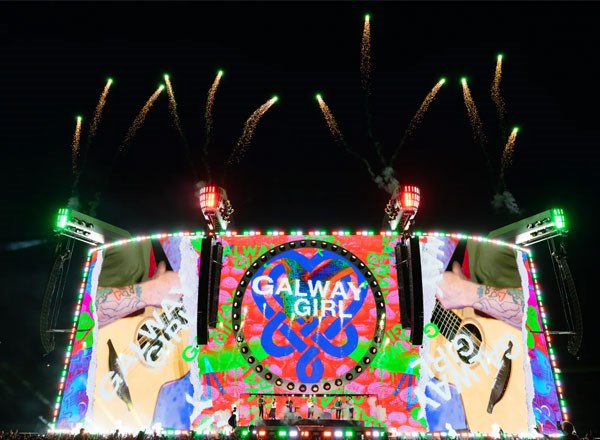
Ed Sheeran's latest global run opened in New Zealand in January before heading to Australia, with dates due across South America and the United States later this year. At the heart of the production's audio is Sennheiser's Spectera, a wideband system that White says has simplified complex RF workflows, enabled seamless coverage between stages and audibly elevated fidelity.
White, who has worked with Sheeran since 2014 and is a long-time Sennheiser user, says the rig has evolved in lockstep with the show's growth. "We've gone through quite a few generations of Sennheiser products over the last 12 years," White recalls. "We always keep updated to get the best sound quality we can and work with new equipment as and when it's appropriate. Over the years, we've moved from Sennheiser's 2000 series to Digital 9000, before switching to Digital 6000 for the 'Mathematics' tour."
That path also brought practical gains through smaller bodypacks, which helped keep the stage uncluttered. "I love things that are small; I don't want to see technology, I just want it to work," White continues. "We went to the tiny theatre-style micro belt packs on the stadium show with the SKM 6000, and it was really good for us. It was nice and scalable. 16 channels of Digital 6000 and 16 channels of 2000 Series IEM was our main rig for the Mathematics tour, and for the fly-pack shows, we went down to four channels of each."
Hearing the first demos of Spectera convinced White it could cut hardware counts and eliminate awkward hand-offs as Sheeran moves between the main stage and a B stage. "We had seen some small demos and I knew, with the stage design of 'The Loop', that Spectera would be perfect for us," he says. "We are covering such a large area; Ed is on the main stage and then seamlessly transitions through to a B stage. If we were managing that with standard analogue IEMs, it would be quite a complicated system with lots of switching and over-gaining amplifiers to get even coverage. It can be done, but with Spectera, everything is off-the-shelf and designed for the job. I'm pretty sure that giving a pre-pre-release product to a major artist doing a tour could have been nerve-racking for the Sennheiser team, but I knew it would be fine. They're very good at what they do."
The switch, made at the start of this year, followed extensive listening tests and tuning of IEMs, handhelds and guitar packs. "Integrating a new piece of technology, especially one that's brand-new, requires a level of testing, so for the move to Spectera, we spent a lot of time comparing IEMs, and tuning the system for the handhelds and guitar packs," White continues. "The big difference with Spectera is that even though on paper the dynamic range and volume response should be the same, it's not. You audibly get far more depth of dynamic range. Ed seems happy with the technology and, in terms of how it works for the show moving forward, the transition was pretty seamless. The techs are happy, too, and said, 'we can actually hear things now'. There's definitely a depth and a clarity we didn't have before."
White acknowledges that early adoption can split opinion. "Some engineers like me love using the very latest technology, while others prefer to wait until every possible test has been run," he says, adding that Sennheiser's validation regime covers the resilience demands of touring, particularly for personal devices.
Front-of-house engineer Simon Kemp reports similar benefits in a show that leans heavily on Sheeran's live vocal and guitar. "Working with Spectera has been great so far," says FOH engineer Simon Kemp. "Moving from 6000 to Spectera has been a real sonic improvement. The sound of Ed's guitars has become even more transparent, and the dynamic range has really helped him move from very quiet, gentle songs to loud, in-your-face moments."
Kemp says the system copes cleanly with the artist's percussive technique. "Ed uses his guitar for percussion and kick drum-like beats, and the pack has been great at handling that while staying very transparent-sounding," he explains. Reliability, he adds, has been unwavering: "Ed's show is unique and has specific requirements from a wireless system, one of them being reliability even in the most challenging outdoor conditions," he says. "We've had no issues so far. We've had shows where we've emptied water out of his guitar and microphone and still had no problems."
For vocals, the team has opted for a Sennheiser capsule tailored to Sheeran's tone. "We're using the MM 445 capsule, which really suits Ed's vocal. The show has no playback or auto-tune; it's very much a singer-songwriter on his own in a huge stadium. There's no hiding behind anything, so I've been very impressed with the clarity the mic delivers, combined with the signal chain being fully digital from the transmitter right through to the speakers. We've managed to achieve clear, present vocals all over the stadium."
Challenging weather has proved no barrier to stable RF. White notes that heavy rain and humidity can sap RF performance, but says Spectera held firm when the tour opened in a downpour in Auckland. "The packs have been extremely resilient. We started this tour in Auckland and the only way I can describe it is the rain was biblical; it just didn't stop. It's the first time I've seen Ed perform in a raincoat," he exclaims. "We didn't have any failures at all with any of the handhelds or the bodypacks. We had five guitars die just due to water ingress, which seemed fair enough, but we didn't have any RF problems. You don't really get much of a harsher environment than out here in Australia. One minute it's 40-45 degree heat, the next minute it's torrential rain."
LED video walls can also stress RF systems, so White has deployed Spectera's DAD antennas over media converters to ensure robust coverage around the colossal screens used in 'The Loop' stage design. Detailing the antenna plan, he adds: "We are using 11 antennas. We have Stage Left side hang, Stage Right side hang, and B stage for each resource," White explains. "We have a 50 by 18-metre video wall; in fact, the whole stage is one big video screen, and we have a set of antennas upstage just to cover that area. Pretty much every port is used on every Spectera unit, but it does mean we have seamless hand-off and coverage from right the way backstage to halfway down the stadium."
Spectera's workflow has also eased RF coordination. Its software enables remote access and virtual setup on Windows and macOS, while the 1U Base Station supports up to 32 simultaneous I/O with flexible routing. "I must admit, when they released the technology, I felt a little bit like my RF coordination knowledge was obsolete," White laughs. "This innovation has shown that, in the future, understanding intermodulation and frequency mapping is going to be a little bit redundant. If you have 30 channels, for example, with a standard narrowband system, you would have to calculate and tune each one individually. With Spectera, you select a centre frequency, and it does all of them for you. You don't need to worry about intermodulation, or about trying to pack in 30 channels – you just say, this 6 or 8 MHz block, this is me. I think it will make wireless far more accessible for people who might previously have been wary of RF. With standard narrowband carriers, a lot of things can happen and if you don't understand the basic maths behind it, it's very easy to get confused. With Spectera wireless is massively simplified. As long as there is a chunk of spectrum to find, you'll be fine."
He runs three Spectera Base Stations across three carriers, including a full backup, and says frequency planning time has plummeted. "We currently run three Spectera Base Stations over three RF carriers for the show, one of which is a complete backup," notes White. "I just need to find three 6 or 8 MHz holes in the frequency spectrum. Previously that would have taken me half an hour to coordinate, but now I'm probably down to seven minutes, even if I go slowly. It's remarkably quick!"
Beyond Sheeran's vocal mics and guitars, Spectera also serves the Irish folk group Beoga, regular guests on the tour. The system's transceiver bodypacks have enabled fully mobile acoustic and triggered sounds for bodhrán player Eamon Murry, among others. "It has been interesting working with Beoga; they're not your standard rock band or pop band. They've got two accordions, a bouzouki, fiddle, keys and the bodhrán," White explains. "Eamon has a snare trigger on his bodhrán that goes straight out of his Roland trigger into a Spectera bodypack and then feeds through to a triggers rack offstage, generates a sample, and comes back in. And we do that with the kick pedal, too, so he can have a kick drum and a snare trigger as well as his drum, but still be pretty much completely mobile. The only thing he's got to pick up is the kick pedal. The sound you get from Beoga is totally different. Spectera has been really handy because most musicians have at least one instrument output and one IEM input. With Spectera being a transceiver, we can get away with using half the number of bodypacks we usually would on any other system."
Monitoring is handled via Sennheiser's WebUI, which exposes live data such as battery status, IEM levels and RF metrics, and supports rapid contingency switching. "I like the WebUI because it gives you more live data quickly, so that's what I use," he says. "I have every single channel and I watch it throughout the show. If there's a problem, I need to be able to see whether it's a Spectera issue or an instrument issue, and I need to define that really quickly. So, I'm constantly looking at the back end of the Spectera units to check out all the level qualities in RSSI and everything else that's going on. Another benefit of the flexibility of Spectera is that I need fewer spare bodypacks. Any bodypack can pick up any stream, so if something goes wrong with one of Ed's bodypacks and his dedicated spare isn't there for whatever reason, a tech can give him another bodypack, I can pick up that MADI stream, and it will switch within seconds."
White is also beta testing manufacturing samples of the forthcoming Spectera handheld, calling it the last key component for a fully unified stage package. Close collaboration with Sennheiser's engineering and relationship teams has supported iterative refinements based on nightly touring use. The operational footprint has shrunk, too. "Spectera has truly made my life in RF so much easier and more manageable, and reduced freight costs," White admits. "On the last tour, our RF rack for all of the in-ears, the combiners and the amplifiers, was a 32U rack. I've completely got rid of that rack and put three Spectera units, with all the chargers, within our existing monitoring equipment. It's cut down on freight costs and it's much more streamlined, which is exactly the way the industry should be going. It's a very good system."
Strong manufacturer support underpins White's long association with Sennheiser. "Clarity and reliability have always been present with Sennheiser," he concludes. "The working relationship is another aspect. If there is a problem, there is such a wealth of knowledge within the company and they're always very happy to come and help us out or field our queries. I've learnt so much from them.
"Part of my job is to keep up to date with everything that's happening in the industry, and we've always said that, although we love working with Sennheiser, if there was a better product, we would probably move to it. Our job is to give the artist the most stable and best audio quality. It just happens to be that, for the last 14 years, that has been Sennheiser. And they keep bringing out good new products. It's one of the reasons we've stuck with Sennheiser for so long, and why we're very happy to keep going with the relationship!"
www.sennheiser.com/en-gb
White, who has worked with Sheeran since 2014 and is a long-time Sennheiser user, says the rig has evolved in lockstep with the show's growth. "We've gone through quite a few generations of Sennheiser products over the last 12 years," White recalls. "We always keep updated to get the best sound quality we can and work with new equipment as and when it's appropriate. Over the years, we've moved from Sennheiser's 2000 series to Digital 9000, before switching to Digital 6000 for the 'Mathematics' tour."
That path also brought practical gains through smaller bodypacks, which helped keep the stage uncluttered. "I love things that are small; I don't want to see technology, I just want it to work," White continues. "We went to the tiny theatre-style micro belt packs on the stadium show with the SKM 6000, and it was really good for us. It was nice and scalable. 16 channels of Digital 6000 and 16 channels of 2000 Series IEM was our main rig for the Mathematics tour, and for the fly-pack shows, we went down to four channels of each."
Hearing the first demos of Spectera convinced White it could cut hardware counts and eliminate awkward hand-offs as Sheeran moves between the main stage and a B stage. "We had seen some small demos and I knew, with the stage design of 'The Loop', that Spectera would be perfect for us," he says. "We are covering such a large area; Ed is on the main stage and then seamlessly transitions through to a B stage. If we were managing that with standard analogue IEMs, it would be quite a complicated system with lots of switching and over-gaining amplifiers to get even coverage. It can be done, but with Spectera, everything is off-the-shelf and designed for the job. I'm pretty sure that giving a pre-pre-release product to a major artist doing a tour could have been nerve-racking for the Sennheiser team, but I knew it would be fine. They're very good at what they do."
The switch, made at the start of this year, followed extensive listening tests and tuning of IEMs, handhelds and guitar packs. "Integrating a new piece of technology, especially one that's brand-new, requires a level of testing, so for the move to Spectera, we spent a lot of time comparing IEMs, and tuning the system for the handhelds and guitar packs," White continues. "The big difference with Spectera is that even though on paper the dynamic range and volume response should be the same, it's not. You audibly get far more depth of dynamic range. Ed seems happy with the technology and, in terms of how it works for the show moving forward, the transition was pretty seamless. The techs are happy, too, and said, 'we can actually hear things now'. There's definitely a depth and a clarity we didn't have before."
White acknowledges that early adoption can split opinion. "Some engineers like me love using the very latest technology, while others prefer to wait until every possible test has been run," he says, adding that Sennheiser's validation regime covers the resilience demands of touring, particularly for personal devices.
Front-of-house engineer Simon Kemp reports similar benefits in a show that leans heavily on Sheeran's live vocal and guitar. "Working with Spectera has been great so far," says FOH engineer Simon Kemp. "Moving from 6000 to Spectera has been a real sonic improvement. The sound of Ed's guitars has become even more transparent, and the dynamic range has really helped him move from very quiet, gentle songs to loud, in-your-face moments."
Kemp says the system copes cleanly with the artist's percussive technique. "Ed uses his guitar for percussion and kick drum-like beats, and the pack has been great at handling that while staying very transparent-sounding," he explains. Reliability, he adds, has been unwavering: "Ed's show is unique and has specific requirements from a wireless system, one of them being reliability even in the most challenging outdoor conditions," he says. "We've had no issues so far. We've had shows where we've emptied water out of his guitar and microphone and still had no problems."
For vocals, the team has opted for a Sennheiser capsule tailored to Sheeran's tone. "We're using the MM 445 capsule, which really suits Ed's vocal. The show has no playback or auto-tune; it's very much a singer-songwriter on his own in a huge stadium. There's no hiding behind anything, so I've been very impressed with the clarity the mic delivers, combined with the signal chain being fully digital from the transmitter right through to the speakers. We've managed to achieve clear, present vocals all over the stadium."
Challenging weather has proved no barrier to stable RF. White notes that heavy rain and humidity can sap RF performance, but says Spectera held firm when the tour opened in a downpour in Auckland. "The packs have been extremely resilient. We started this tour in Auckland and the only way I can describe it is the rain was biblical; it just didn't stop. It's the first time I've seen Ed perform in a raincoat," he exclaims. "We didn't have any failures at all with any of the handhelds or the bodypacks. We had five guitars die just due to water ingress, which seemed fair enough, but we didn't have any RF problems. You don't really get much of a harsher environment than out here in Australia. One minute it's 40-45 degree heat, the next minute it's torrential rain."
LED video walls can also stress RF systems, so White has deployed Spectera's DAD antennas over media converters to ensure robust coverage around the colossal screens used in 'The Loop' stage design. Detailing the antenna plan, he adds: "We are using 11 antennas. We have Stage Left side hang, Stage Right side hang, and B stage for each resource," White explains. "We have a 50 by 18-metre video wall; in fact, the whole stage is one big video screen, and we have a set of antennas upstage just to cover that area. Pretty much every port is used on every Spectera unit, but it does mean we have seamless hand-off and coverage from right the way backstage to halfway down the stadium."
Spectera's workflow has also eased RF coordination. Its software enables remote access and virtual setup on Windows and macOS, while the 1U Base Station supports up to 32 simultaneous I/O with flexible routing. "I must admit, when they released the technology, I felt a little bit like my RF coordination knowledge was obsolete," White laughs. "This innovation has shown that, in the future, understanding intermodulation and frequency mapping is going to be a little bit redundant. If you have 30 channels, for example, with a standard narrowband system, you would have to calculate and tune each one individually. With Spectera, you select a centre frequency, and it does all of them for you. You don't need to worry about intermodulation, or about trying to pack in 30 channels – you just say, this 6 or 8 MHz block, this is me. I think it will make wireless far more accessible for people who might previously have been wary of RF. With standard narrowband carriers, a lot of things can happen and if you don't understand the basic maths behind it, it's very easy to get confused. With Spectera wireless is massively simplified. As long as there is a chunk of spectrum to find, you'll be fine."
He runs three Spectera Base Stations across three carriers, including a full backup, and says frequency planning time has plummeted. "We currently run three Spectera Base Stations over three RF carriers for the show, one of which is a complete backup," notes White. "I just need to find three 6 or 8 MHz holes in the frequency spectrum. Previously that would have taken me half an hour to coordinate, but now I'm probably down to seven minutes, even if I go slowly. It's remarkably quick!"
Beyond Sheeran's vocal mics and guitars, Spectera also serves the Irish folk group Beoga, regular guests on the tour. The system's transceiver bodypacks have enabled fully mobile acoustic and triggered sounds for bodhrán player Eamon Murry, among others. "It has been interesting working with Beoga; they're not your standard rock band or pop band. They've got two accordions, a bouzouki, fiddle, keys and the bodhrán," White explains. "Eamon has a snare trigger on his bodhrán that goes straight out of his Roland trigger into a Spectera bodypack and then feeds through to a triggers rack offstage, generates a sample, and comes back in. And we do that with the kick pedal, too, so he can have a kick drum and a snare trigger as well as his drum, but still be pretty much completely mobile. The only thing he's got to pick up is the kick pedal. The sound you get from Beoga is totally different. Spectera has been really handy because most musicians have at least one instrument output and one IEM input. With Spectera being a transceiver, we can get away with using half the number of bodypacks we usually would on any other system."
Monitoring is handled via Sennheiser's WebUI, which exposes live data such as battery status, IEM levels and RF metrics, and supports rapid contingency switching. "I like the WebUI because it gives you more live data quickly, so that's what I use," he says. "I have every single channel and I watch it throughout the show. If there's a problem, I need to be able to see whether it's a Spectera issue or an instrument issue, and I need to define that really quickly. So, I'm constantly looking at the back end of the Spectera units to check out all the level qualities in RSSI and everything else that's going on. Another benefit of the flexibility of Spectera is that I need fewer spare bodypacks. Any bodypack can pick up any stream, so if something goes wrong with one of Ed's bodypacks and his dedicated spare isn't there for whatever reason, a tech can give him another bodypack, I can pick up that MADI stream, and it will switch within seconds."
White is also beta testing manufacturing samples of the forthcoming Spectera handheld, calling it the last key component for a fully unified stage package. Close collaboration with Sennheiser's engineering and relationship teams has supported iterative refinements based on nightly touring use. The operational footprint has shrunk, too. "Spectera has truly made my life in RF so much easier and more manageable, and reduced freight costs," White admits. "On the last tour, our RF rack for all of the in-ears, the combiners and the amplifiers, was a 32U rack. I've completely got rid of that rack and put three Spectera units, with all the chargers, within our existing monitoring equipment. It's cut down on freight costs and it's much more streamlined, which is exactly the way the industry should be going. It's a very good system."
Strong manufacturer support underpins White's long association with Sennheiser. "Clarity and reliability have always been present with Sennheiser," he concludes. "The working relationship is another aspect. If there is a problem, there is such a wealth of knowledge within the company and they're always very happy to come and help us out or field our queries. I've learnt so much from them.
"Part of my job is to keep up to date with everything that's happening in the industry, and we've always said that, although we love working with Sennheiser, if there was a better product, we would probably move to it. Our job is to give the artist the most stable and best audio quality. It just happens to be that, for the last 14 years, that has been Sennheiser. And they keep bringing out good new products. It's one of the reasons we've stuck with Sennheiser for so long, and why we're very happy to keep going with the relationship!"
www.sennheiser.com/en-gb
Top Broadcast News Stories
01/05/2026
Sennheiser Group To Showcase End-To-End Audio Ecosystem At MPTS 2026
The Sennheiser Group will unveil its latest professional audio portfolio at the Media Production & Technology Show (MPTS) 2026, returning to Olympia L
Sennheiser Group To Showcase End-To-End Audio Ecosystem At MPTS 2026
The Sennheiser Group will unveil its latest professional audio portfolio at the Media Production & Technology Show (MPTS) 2026, returning to Olympia L
01/05/2026
DPA Piano Kit Helps Jamie Harley Capture Yann Tiersen's Nuance On Tour
Presenting the full emotional breadth of a solo piano through a large PA is notoriously demanding, particularly with an artist as subtle and textural
DPA Piano Kit Helps Jamie Harley Capture Yann Tiersen's Nuance On Tour
Presenting the full emotional breadth of a solo piano through a large PA is notoriously demanding, particularly with an artist as subtle and textural
01/05/2026
Harmonic To Showcase AI-Powered Fibre Innovations At Fiber Connect 2026
Harmonic will unveil a slate of new technologies at Fiber Connect 2026 designed to help fibre service providers move to proactive operations at scale,
Harmonic To Showcase AI-Powered Fibre Innovations At Fiber Connect 2026
Harmonic will unveil a slate of new technologies at Fiber Connect 2026 designed to help fibre service providers move to proactive operations at scale,
01/05/2026
Panavision Appoints Fritz Heinzle As Vice President Of Sales
Panavision, a leading provider of production solutions to the global entertainment sector, has named Fritz Heinzle as Vice President of Sales. Reporti
Panavision Appoints Fritz Heinzle As Vice President Of Sales
Panavision, a leading provider of production solutions to the global entertainment sector, has named Fritz Heinzle as Vice President of Sales. Reporti
01/05/2026
CPI Media Enhances Socio-Religious Broadcasts with QuickLink StudioCall
CPI Media, a voluntary organization within the Missionary Society of St Paul (MSSP) and a leading media house dedicated to producing socio-religious c
CPI Media Enhances Socio-Religious Broadcasts with QuickLink StudioCall
CPI Media, a voluntary organization within the Missionary Society of St Paul (MSSP) and a leading media house dedicated to producing socio-religious c
01/05/2026
Jacksonville State Boosts Division I Broadcasts With Dante-Based Studio Technologies Backbone
Jacksonville State University (Jax State), a proud NCAA Division I member of Conference USA, has revamped its athletics broadcast operation with a com
Jacksonville State Boosts Division I Broadcasts With Dante-Based Studio Technologies Backbone
Jacksonville State University (Jax State), a proud NCAA Division I member of Conference USA, has revamped its athletics broadcast operation with a com
01/05/2026
Tigo Sports Modernises Broadcast Infrastructure With Ateme
Tigo Sports, Paraguay's leading sports broadcaster, has completed a full modernisation of its video workflows with solutions from Ateme, boosting the
Tigo Sports Modernises Broadcast Infrastructure With Ateme
Tigo Sports, Paraguay's leading sports broadcaster, has completed a full modernisation of its video workflows with solutions from Ateme, boosting the
01/05/2026
Hitomi Unveils MatchBox Panorama's UK Debut At MPTS 2026
Positioned to give engineers a single, consolidated view of timing across complex production chains, MatchBox Panorama aggregates latency and lip sync
Hitomi Unveils MatchBox Panorama's UK Debut At MPTS 2026
Positioned to give engineers a single, consolidated view of timing across complex production chains, MatchBox Panorama aggregates latency and lip sync
30/04/2026
Brompton Technology Powers Record-Breaking Royal Edinburgh Military Tattoo
Brompton Technology’s Tessera LED video processors delivered a landmark performance at the Royal Edinburgh Military Tattoo’s 75th-anniversary tour, as
Brompton Technology Powers Record-Breaking Royal Edinburgh Military Tattoo
Brompton Technology’s Tessera LED video processors delivered a landmark performance at the Royal Edinburgh Military Tattoo’s 75th-anniversary tour, as
30/04/2026
ARRI Introduces cforce MAX: A High-Performance Lens Motor Upgrade
ARRI introduces the cforce MAX, a new high-performance lens motor that enhances the Hi-5 lens control system with its exceptional speed and intelligen
ARRI Introduces cforce MAX: A High-Performance Lens Motor Upgrade
ARRI introduces the cforce MAX, a new high-performance lens motor that enhances the Hi-5 lens control system with its exceptional speed and intelligen