Menu



BROADCAST FILM AND VIDEO DIRECTORY
Broadcast News

25/11/2026
Calrec Sees Open Software Reshaping Broadcast Audio
Open, software-defined production could give broadcasters more flexibility over how they make live programmes and manage costs, according to Henry Goodman, Calrec’s director of product management.
In an interview first published in Production 360, Goodman said discussions at the 2026 IBC show highlighted demand for systems that allow broadcasters to choose how they work, rather than replacing one closed platform with another.
Ahead of the show, Calrec announced plans to add Media eXchange Layer (MXL) support to its ImPulseV virtual audio mixing engine as part of its work on the European Broadcasting Union’s Dynamic Media Facility (DMF) project. The company previewed related ImPulseV enhancements at IBC.
Goodman said the DMF concept envisages a shared server stack capable of hosting the production software a facility needs, allowing users to select tools for each job. He argued that broadcasters increasingly want production spending to reflect the scale of the work, as well as seeking capable mixing consoles.
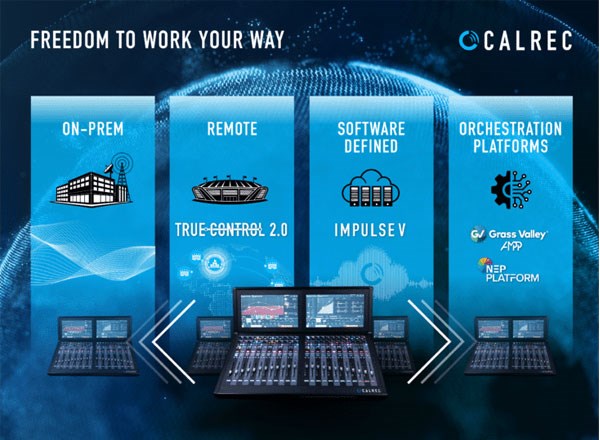
At IBC, Calrec demonstrated its Argo ecosystem, combining physical and virtualised interfaces with ImPulseV. Goodman said the system can operate on site, remotely or in virtualised environments, and can connect through orchestration platforms including Grass Valley’s AMPP and NEP’s Platform.
The demonstration brought together Argo S and Argo M consoles, True Control 2.0 remote production software, an ImPulse IP processing core and ImPulseV. Three consoles at the show were linked to a fourth at Calrec’s UK headquarters, with each configured differently to illustrate remote production options.
Calrec also launched Type RT, its most compact all-in-one digital console, at IBC 2026. Goodman said it combines features from the Argo and Type R platforms and is intended for uses ranging from broadcasting to podcast studios, sports venues and corporate events. The unit includes digital signal processing, control processing, input and output connections, monitoring and USB audio connectivity.
Goodman said the move towards IP workflows is driven largely by commercial pressures, including fragmented audiences, rising rights costs and tight margins. He pointed to Munich-based DMC Production as an example of a company adopting a software-defined approach.
Working with Calrec and Grass Valley, DMC unveiled two identical remote production vehicles, AR 1 and AR 2, built by systems integrator Broadcast Solutions. DMC describes their outside broadcast model as “reverse remote production”.
Under that arrangement, production-critical tasks, including video switching, replay, recording and audio mixing, take place at the venue in a cloud-native Grass Valley AMPP environment, while teams operate the systems remotely from DMC’s broadcast centres. Goodman said this avoids sending raw production feeds back to a central facility and can allow a large multi-camera production to be handled over a 100 Mbit/s internet connection.
He added that DMC and Calrec had developed an audio network intended to provide seamless connections and low-latency control through a familiar interface. However, he stressed that broadcasters need not switch entirely to IP at once: many use a mixture of on-site, remote and virtualised production.
Calrec’s Apex M6, a compact modular input and output platform that can operate independently of its consoles, is aimed at broadcasters moving towards IP, expanding networks or working with mixed formats, Goodman said.
He identified vendor lock-in as a principal concern for audio customers, warning that closed software platforms can restrict broadcasters much as proprietary hardware did. He said MXL is designed to let software from different suppliers run on the same server and exchange video, audio and metadata in real time.
Another challenge is investing in sufficient capacity without paying for resources that are not always needed. Goodman said Calrec has introduced smaller ImPulseV processing packs and short-term licences lasting from four weeks, allowing customers to add capacity for a job and release it afterwards. He also said True Control 2.0 aims to provide operators with a consistent experience regardless of their distance from the processing equipment.
On immersive audio, Goodman said the format has proved its value in major sports and events productions, with further growth likely to depend on making it practical for more content. He said fast configuration, automation and the ability to adjust audio path widths are important, while artificial intelligence and machine learning are growing areas of development for assistive mixing tools.
Looking ahead, Goodman expects remote production to help smaller broadcasters create more niche content and reach audiences outside traditional outside broadcast workflows. He said some are also using direct-to-consumer streaming models to make money from a wider range of live content with existing infrastructure.
For 2027, Calrec plans further updates on its EBU DMF work, including MXL support for ImPulseV, as well as its integrations with Grass Valley AMPP and NEP Platform.
calrec.com/

Top Broadcast News Stories
25/11/2026
5SOS Engineers Use Quantum 338 Consoles On Tour
5 Seconds of Summer's audio engineers are using DiGiCo Quantum 338 consoles at front of house and monitors to accommodate changing setlists and a rang
5SOS Engineers Use Quantum 338 Consoles On Tour
5 Seconds of Summer's audio engineers are using DiGiCo Quantum 338 consoles at front of house and monitors to accommodate changing setlists and a rang
25/11/2026
Genelec Adds Two To Western Europe Team
Genelec has appointed Gilles Pétrotey and Nicolas Cherencq to its Western Europe team, with both focusing on sales and customer support in French-spea
Genelec Adds Two To Western Europe Team
Genelec has appointed Gilles Pétrotey and Nicolas Cherencq to its Western Europe team, with both focusing on sales and customer support in French-spea
25/11/2026
München.tv Upgrades Production Centre With Riedel
Regional broadcaster münchen.tv has upgraded its production infrastructure at a new site in northern Munich, using Riedel technology for signal distri
München.tv Upgrades Production Centre With Riedel
Regional broadcaster münchen.tv has upgraded its production infrastructure at a new site in northern Munich, using Riedel technology for signal distri
25/11/2026
Grass Valley Adds ZoomISO Cloud To AMPP
Grass Valley has announced that ZoomISO Cloud is available as a native application within AMPP, its cloud-based production platform. The integration a
Grass Valley Adds ZoomISO Cloud To AMPP
Grass Valley has announced that ZoomISO Cloud is available as a native application within AMPP, its cloud-based production platform. The integration a
25/11/2026
SGO Launches Workflows Bridge For EDL Automation
SGO has announced Workflows Bridge, a new addition to its Workflows Suite designed to help post-production facilities check incoming edit decision lis
SGO Launches Workflows Bridge For EDL Automation
SGO has announced Workflows Bridge, a new addition to its Workflows Suite designed to help post-production facilities check incoming edit decision lis
25/11/2026
Calrec Sees Open Software Reshaping Broadcast Audio
Open, software-defined production could give broadcasters more flexibility over how they make live programmes and manage costs, according to Henry Goo
Calrec Sees Open Software Reshaping Broadcast Audio
Open, software-defined production could give broadcasters more flexibility over how they make live programmes and manage costs, according to Henry Goo
24/11/2026
Marshall Camera Supports Mochakk’s Coachella Visuals
Creative production company Media Pollution used a Marshall Electronics CV228 All-Weather HD Lipstick Camera to create live visuals for DJ Mochakk's S
Marshall Camera Supports Mochakk’s Coachella Visuals
Creative production company Media Pollution used a Marshall Electronics CV228 All-Weather HD Lipstick Camera to create live visuals for DJ Mochakk's S
24/11/2026
Gravity Media Cameras Capture Macau Grand Prix Action
Gravity Media supplied 45 Australian-designed specialist cameras for coverage of the 2026 Macau Grand Prix, continuing its long-standing involvement i
Gravity Media Cameras Capture Macau Grand Prix Action
Gravity Media supplied 45 Australian-designed specialist cameras for coverage of the 2026 Macau Grand Prix, continuing its long-standing involvement i
24/11/2026
Spectrum News Adopts Amagi Cloud Platform
Spectrum News has deployed Amagi's cloud platform to support its live news operations, the media technology provider has announced. Amagi said the pla
Spectrum News Adopts Amagi Cloud Platform
Spectrum News has deployed Amagi's cloud platform to support its live news operations, the media technology provider has announced. Amagi said the pla
24/11/2026
BBC Warns Of 2038 TV Date Problem
BBC Research and Development has warned that some televisions on sale today could encounter date-related problems that stop their electronic programme
BBC Warns Of 2038 TV Date Problem
BBC Research and Development has warned that some televisions on sale today could encounter date-related problems that stop their electronic programme